Are Power Banks Allowed on Planes?
As an Amazon Associate I earn from qualifying purchases.
Power banks are one of the most misunderstood items in a carry-on. The short answer is yes, you can bring them, but only under specific rules that most travelers never read until a gate agent stops them. The rules come down to battery capacity and where you pack it. Here is what actually matters so your charger flies with you instead of getting confiscated at security.
Power banks must go in your carry-on
Lithium battery power banks are never allowed in checked luggage. Airlines require them in your carry-on or personal item because a battery fault in the cabin can be seen and dealt with immediately, while a fire in the cargo hold cannot. This rule is close to universal across airlines and countries, so treat it as fixed no matter where you are flying.
This has a practical packing consequence. Keep every battery, spare charger, and power bank in the bag that stays with you in the cabin, and never let one drift into a bag you plan to check. If you get asked to gate-check your carry-on on a full flight, pull the power banks out and carry them on your person before you hand the bag over.
Understand the 100Wh limit
The key number is watt-hours, written as Wh. Power banks up to 100Wh are allowed without any airline approval, which covers the vast majority of consumer models. Between 100Wh and 160Wh you typically need airline permission and are limited to two spares. Above 160Wh, power banks are banned from passenger flights entirely, so this range almost never applies to normal travel gear.
Most everyday power banks sit well under 100Wh, so you rarely have a problem. The trouble comes with large high-capacity units marketed for laptops or camping, which can cross the line. When in doubt, the 100Wh threshold is the one figure to memorize, because it is the boundary that decides whether your battery flies freely or needs a conversation at the gate.
How to read your battery's capacity
Many power banks list capacity in milliamp-hours, or mAh, not watt-hours, which causes most of the confusion. To convert, multiply the mAh rating by the voltage, usually 3.7V for lithium cells, then divide by 1000. A 20000mAh bank works out to roughly 74Wh, comfortably under the limit. A 27000mAh unit lands near 100Wh, which is where you start paying attention.
Good manufacturers print the Wh figure directly on the casing, so check there first before doing any math. If only mAh is shown, do the conversion at home and keep the number in mind. Security staff can ask, and being able to point to a clearly labeled capacity under 100Wh turns a potential holdup into a five second check.
Pack chargers and cables sensibly
Beyond the battery itself, keep your charging kit organized and accessible. Security may want to see power banks separately, and a tangle of cables buried in a bag slows everyone down. A small tech pouch that holds your bank, cables, and wall charger together lets you lift the whole kit out in one motion at the checkpoint.
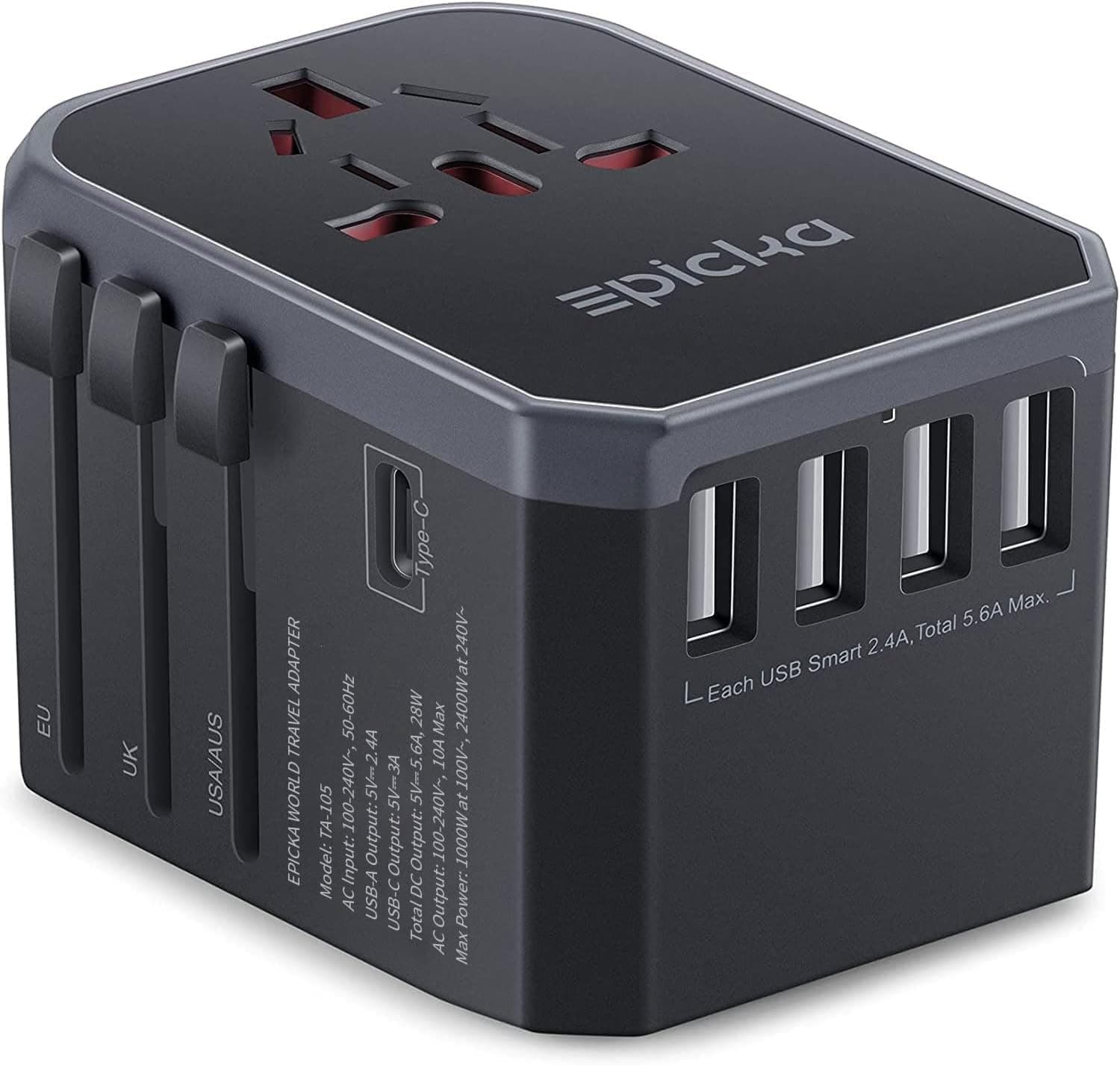
Bring the right wall adapter for your destination too, since a dead power bank is useless without a way to recharge it. Pairing a compact multi-country adapter with your power bank means you can top up overnight anywhere and start each day with a full charge, which matters most on long travel days when outlets are scarce.
Follow the rules to avoid delays
Rules vary slightly by airline and country, so if you carry a larger battery or fly a budget or regional carrier, check that specific airline's policy before you go. A two minute look at their dangerous goods page can save you from surrendering an expensive power bank at security, which happens more often than most travelers expect.
For nearly everyone, the guidance is simple. Keep power banks under 100Wh, pack them in your carry-on, and have the capacity clearly labeled. Do those three things and your batteries will pass through security without drama, letting you focus on the trip instead of a confiscated charger and a scramble to replace it abroad.