Staying Organized With Cables and Tech While Traveling
Published How we research
Tech is the quiet chaos agent of any travel bag. Left loose, cables tangle themselves into knots, adapters migrate to the bottom, and you inevitably leave one charger plugged into a hotel wall two cities ago. The fix is not more gadgets but a deliberate system: one home for everything electronic, a habit of putting things back, and a ruthless approach to what you bring in the first place. Get this right and your tech stops eating your time and your patience.
Products from this article
The highest-scoring picks from the buying guides this article links to. Scores are our editorial assessment, not customer ratings.
As an Amazon Associate we earn from qualifying purchases. This does not change our picks. Affiliate disclosure
+ Origami-style layout with elastic loops keeps chargers, cables, pens and SD cards visible instead of tangled
From our guide: Best Cable Organizers for One-Bag Travel
+ Foldable prongs stop the charger scratching other gear in your bag
From our guide: Best GaN Travel Chargers for One-Bag Travel
+ Smaller footprint fits slings and personal-item bags where the full pouch will not
From our guide: Best Cable Organizers for One-Bag Travel
+ 4-Port layout means fewer chargers in your tech pouch
From our guide: Best GaN Travel Chargers for One-Bag Travel
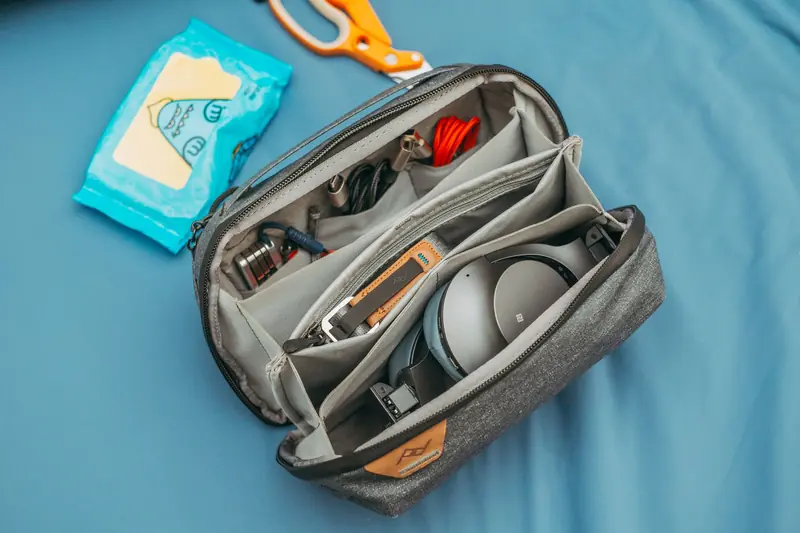
The foundation is a single dedicated tech pouch. Instead of scattering cables through pockets, corral every charger, cable, and small device into one organizer with elastic loops and mesh sections. This does two things: it keeps everything untangled, and it gives you one object to check before leaving any room. When all your electronics live in one place, a forgotten charger becomes obvious the moment you glance inside the pouch.
Reducing the number of cables is more effective than organizing them well. Audit what you actually carry and consolidate ruthlessly. A short multi-headed charging cable that serves several device types can replace three separate cords. A single compact wall charger with multiple ports can power your phone, headphones, and laptop at once from one outlet, which also solves the perennial problem of too few sockets in older hotel rooms. Every cable you eliminate is one less thing to tangle or lose.
Adapters deserve careful thought, because plug standards vary by region and a dead battery in the wrong country is genuinely stranding. One good universal adapter usually beats a drawer of country-specific plugs, and many now include built-in ports so they double as a charger. Bring a power bank sized to your needs, and remember airlines require it in your carry-on, never checked. Keep the adapter and power bank in the tech pouch so your entire power system travels as one unit.
Cable management tricks keep the pouch from becoming its own mess. Coil cables and secure them with small reusable ties, velcro straps, or even hair ties so they cannot unravel and grab their neighbors. Wind earbud cords or store wireless buds in their case rather than loose. A few small zip bags inside the pouch separate categories, so charging gear, audio, and spare memory cards do not migrate into one indistinguishable clump.
Protect the fragile and the important. A slim laptop or tablet sleeve guards screens from the pressure and knocks of a packed bag. Keep small, easily lost items like memory cards, a spare SIM, and a SIM ejector tool in a tiny labeled pouch, because these are the things that vanish exactly when you need them. Back up photos and documents to the cloud when you have wifi, so a lost or stolen device is a financial annoyance rather than a loss of your memories.
The last piece is a simple leaving routine. Before you check out of anywhere, do a quick sweep of outlets and the bedside table, then confirm your tech pouch feels complete. Chargers left behind are the most common travel loss, and they always seem to be plugged in low near the floor where you forget them. A ten-second habit of checking every socket, every time, saves you from replacing gear in an unfamiliar city.
Popular right now
- Best Personal Item Bags and Slings for One-Bag TravelBuying guide
- Clamshell opening explainedGlossary
- Best Merino Wool Socks for TravelBuying guide
- Best Travel First Aid Kits for One-Bag TravelBuying guide
- Best Weekender Bags for One-Bag Short TripsBuying guide
- Best Compact Travel Umbrellas for One-Bag TravelBuying guide
Based on the last 28 days of search and visitor data.