Peak Design Travel Backpack 45L, Black, Expandable 35-45L Design, Rear and Top Access, Weatherp Review (2026)
Updated September 20, 2026 · Research-based review
Our verdict
Peak Design's Travel Backpack 45L suits photographers and gear-heavy travelers who want one bag that expands from a daily-carry size to a full carry-on. The weatherproof build and rear access are real strengths, but the camera cube sells separately and the bag runs large and heavy when fully expanded.
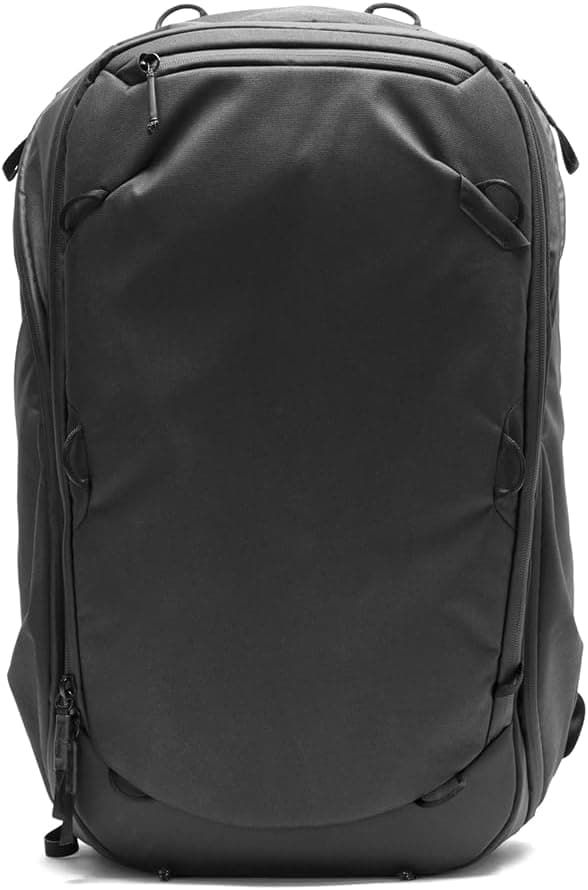
Peak Design's Travel Backpack 45L in black, expandable from 35-45L with rear and top access for photographers who fly.
Price range: $$$ (Premium)
What we liked
- + Expands from 35 to 45L, so it works as a daily bag and a full carry-on
- + Rear access keeps the main compartment against your back, which deters pickpockets
- + Weatherproof build protects cameras and clothing during wet travel days
Trade-offs
- - Camera cube is sold separately, so the price climbs for a full photo setup
- - Large and heavy when fully expanded for smaller travelers
Who this backpack fits
This backpack is aimed at travelers, and photographers in particular, who want a single bag that can shrink down for daily use around a city and expand for a longer trip rather than owning separate bags for each purpose. The expandable design means it can work as a 35 liter daily bag most of the time and unzip to 45 liters when packing for a longer trip, which suits people who travel often but do not want two different backpacks taking up closet space. Photographers who already own or plan to buy Peak Design's separate camera cubes get the most out of this bag, since the interior is built around modular inserts rather than fixed padded compartments. Travelers who want a simple, lightweight carry-on without much structure may find this backpack heavier and more complex than they need.
Expandable capacity
The backpack starts at a standard 35 liters, which meets typical international carry-on size limits, and expands to 45 liters through zippers along the sides of the main compartment, adding extra depth for a longer trip without needing a second bag. This flexibility is the headline feature, letting one bag serve as a daily commuter pack most of the year and a full carry-on for a two-week trip when needed, though travelers should confirm their specific airline's sizer before relying on the fully expanded 45 liter size as guaranteed carry-on. The trade-off for this flexibility is a bag that is inherently more complex, with more zippers and moving parts than a fixed-size backpack, which adds some weight and a slightly steeper learning curve to figure out the packing system.
Access and weatherproofing
Peak Design built the main compartment with both rear-panel and top access, so the bag can be opened against a wall or your back in a crowded space, which deters someone from reaching into an open bag from the front while you are wearing it. The exterior shell uses a recycled nylon fabric the brand calls Versa Shell, treated with a water-repellent coating and double poly coating for weather resistance, aimed at keeping cameras, laptops and clothing dry through a sudden downpour rather than a full submersion. A padded sleeve fits laptops up to 16 inches, and the overall build leans toward protecting expensive gear from both weather and casual theft rather than being the lightest possible option in this size class.
Camera gear and cost
Peak Design sells dedicated camera cubes separately from the backpack itself, which is worth budgeting for if the goal is carrying camera bodies and lenses, since the bag on its own is a well-built travel pack rather than a padded camera bag until a cube is added inside it. This separate purchase is part of why the overall cost climbs for a full photography setup, and it is a fair trade-off to be aware of before buying, since travelers who do not need dedicated camera padding can skip the cube and use the space for clothing and gear instead. The backpack itself weighs about 4.5 pounds empty, which is heavier than simpler carry-on backpacks, a direct result of the structured panels, expansion zippers and weatherproof shell needed to support both photography use and general travel.
How it compares
Against the Osprey Farpoint 40 and NOMATIC 40L bags, Peak Design's Travel Backpack is the most expensive and most photography-focused option, justified mainly for travelers who specifically need the rear access and camera cube compatibility rather than general one-bag travel. Compared with dedicated camera backpacks like the Lowepro Flipside line, this Peak Design bag is more useful for travelers who also need to pack clothing and daily items alongside camera gear, since it is built as a travel bag first and a camera bag second. For a one-bag kit centered on photography, this backpack is a strong anchor piece, though the total cost with a camera cube added should be weighed against simpler travel backpacks if camera protection is not the primary need.
Frequently asked questions
What is the capacity range of the Peak Design Travel Backpack 45L?
It expands from a standard 35 liters up to 45 liters through zippers along the main compartment, letting it work as both a daily bag and a full carry-on.
Does the Peak Design Travel Backpack include a camera cube?
No, Peak Design sells camera cubes separately, so a full camera setup costs more than the backpack price alone.
How much does the Peak Design Travel Backpack 45L weigh?
It weighs about 4.5 pounds empty, which is heavier than simpler carry-on backpacks due to its expandable panels and weatherproof shell.
Is the Peak Design Travel Backpack waterproof?
It is weatherproof rather than fully waterproof, using a water-repellent coated recycled nylon shell that resists rain rather than full submersion.
Prices change often, so check the current price and availability on Amazon.
Check price on AmazonOne Bag Picks may earn a commission from the link above.